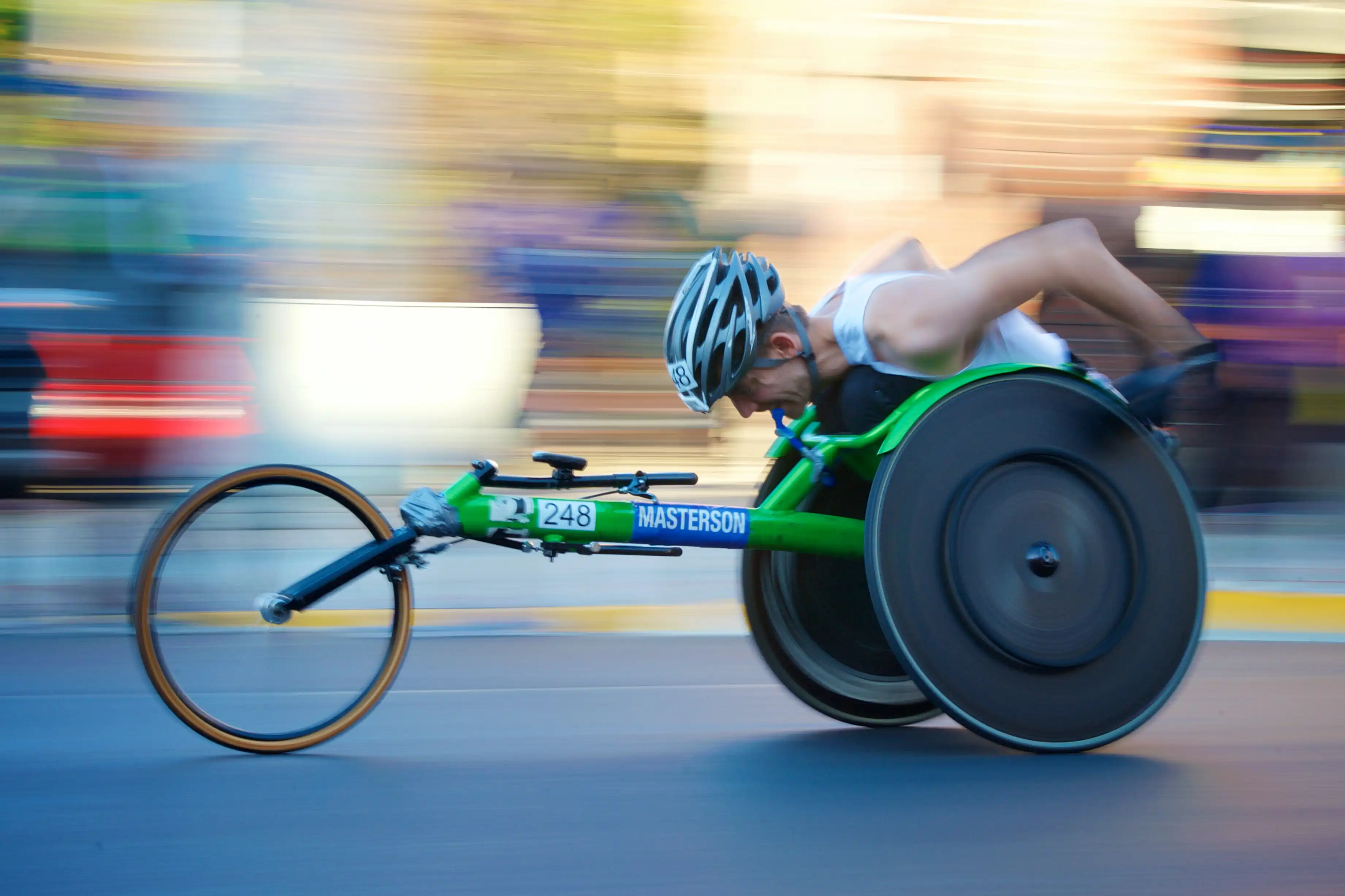
Pacing of a racing roll chair in a fivefold and ten times Ironman

Pacing strategy of a wheelchair athlete in a 5x and 10x Ironman ultra triathlon: a case study For disabled athletes like wheelchair users there is no knowledge of competitions and pacing during a long-distance triathlon like an Ironman triathlon. The aim of this study was to examine the pacing strategy of a cross-sectional wheelchair sports enthusiast, which has a Quintuple Iron Ultra Triathlon (five times 3.8 km swim, 180 km handbike cycling and 42.195 km wheelchair race in five days) and a Deca Iron Ultra-Triathlon(10 times the same distance in 10 days) completed and ended. Data was collected from an ultra-triathlon race (Swissultra) over 5x and 10x Ironman distance.Official data was retrieved from the website of the racing organizer and the personal information of the athlete by the athlete by online interviews. The athlete is a 1962 born man.The races analyzed in this study took place in the summer of 2017 (5x) and 2019 (10x). The intermediate times for swimming, cycling and running, the total times for each Ironman and lap times when cycling (handbike) and running (wheelchair) were analyzed.The athlete ended the Quintuple Iron Ultra Triathlon in a total runtime of 66:28:31 H: Min: S and the Deca Iron Ultra-Triathlon in 137: 03: 20 h: min: s. He drove a uniform pace in both races in both disciplines and for the entire competition time.The cross-sectional wheelchair sports enthroned could end both a fivefold and a Deca Iron Ultra-Triathlon by taking a uniform tempo in all separate disciplines and for the entire competition time. Triathlon is a growing sport for athletes with spinal cord injuries. Ultra triathlons are ultra-endurance events and the tempo is a key aspect for a successful race, regardless of the category of the athlete.

Read more
What influences the performance with a triathlon about the Olympic distance?

Previous experience, aerobic capacity and body composition are the best predictors for Olympic distance triathlon performance: Predictors in amateur triathlon The present study examines predictors for the entire competition time and the individual disciplines in a triathlon over the Olympic distance. Ninn-thirty male and six female triathlets were examined for anthropometric, physiological, genetic, training-related, clinical and circadian properties. The body composition, the maximum capacity for oxygen uptake, the maximum aerobic speed, the anaerobic threshold, the triathlon experience and the genotype for α-actinin 3 influenced the entire competition time. The entire competition time can be predicted with the maximum aerobic speed, the triathlon experience and the percentage of lean mass. Swimming can be predicted by the maximum aerobic speed, the triathlon experience and the anaerobic threshold. Cycling can be predicted on the basis of the maximum aerobic speed, the triathlon experience and percentage of the lean mass. When running, the maximum aerobic speed was the only parameter that was present in the best multiple linear regression model.

Read more

What influences the fitness level of half marathon runners?

Health and Wellness Status Perception of Half-Marathon Runners: Influence of Age, Sex, Injury, and Training with Qualified Staff The aim of this study was to analyze the perception of health and wellness status in amateur half marathon runners by gender, age, injury or non-violation in the two months before the race and to receive the support or non-support of qualified personnel for the race preparation. At the study, 644 half-marathon athletes participated in amateur levels (515 men and 107 women; 41.5 ± 10,1 years).One week before participating in a half marathon, the participants answered the Hooper Index and the SF-36 questionnaire. Women gave a higher stress in front of the competition than men, and the group of runners of <40 years stated that they were more tired in comparison to the group of> 40 years.Women showed a better quality of life in physical and emotional rolling dimensions, and the group of> 40 years showed a better quality of life in the emotional rolling dimension. The group that had suffered an injury (Injuryyes), described a stronger muscle cat (Musclsore), and the group that had qualified personnel (Qualifstaffyes), explained a higher level of stress and fatigue. The Injury No (Injuryno) group showed a better quality of life in the dimension of the physical function. The group without qualified personnel (Qualifstaffno) showed a better quality of life in the dimensions of body pain, general health, vitality, social function and spiritual health, while the Qualifstaffyes Group showed better results in the dimensions physical function and emotional role.

Read more

The body composition for long-distance runs

Body composition among long distance runners The current study aimed to examine the body composition of adult male ultra-trail runners after their participation (regional versus national) (regional ultra-trail runners against national ultra-trail runners). The body composition were examined by the so-called air displacement plethysmography, the so-called bioelectrical impedance, and the so-called dual-energy x-ray absorptiometry.In addition, the so-called Food Frequency Questionnaire was used. Significant differences between the different groups of different groups were detected for the chronological age (regional ultra-trail runners 38.8 ± 8.2 ± 3.1 years 38.8 ± 8.2 ± 4.1 years);Body density (regional ultra-trail runners 1.062 ± 0.015 l / kg against national ultra-trail runners 1.074 ± 0.009 l / kg);and fat mass (regional ultra-trail runner 12.7 ± 6.8 kg against national ultra-trail runners 7.6 ± 2.7 kg). National ultra-trail runners were younger, showed higher values for body density and had less fatty mass, although no significant differences were found for the fat-free mass.

Read more

What influences the motivation with marathon runners?

Do Sex, Age and Marital Status Influence the Motivations of Amateur Marathon Runners? The Poznan Marathon Case Study The purpose of this study was to describe reasons to participate in a marathon and their context with marital status, age and gender. A total of 433 runners, of which 144 women and 349 men, completed the Polish version of the so-called Motivation of Marathoners Scale with 9 dimensions published as part of an online survey at the Pozen Marathon in Poland (2019). The age of athletes (19-25, 26-35, 36-50, 51-70 years) and the civil level (single, married, divorced) were queried by the participants. The results showed that statistically significant associations between the motivational aspects of the athletes and the sex and age of the athletes were found.For this purpose, three dimensions of the Motivational of Marathoners Scale - statistically associated with the gender of the athletes, another three dimensions were different due to age, and finally, the civil level in none of the dimensions showed differences. In addition, in the multivariate analysis, in the civil level, gender and age group were compared according to the motivation of Marathoners Scale, no statistical differences were found.

Read more

Long-term run of the performance of the two best ultratriathletes

Longitudinal Performance Analysis in Ultra-Triathlon of the World’s 2 Best Master Triathlete This case study includes the analysis of the services of two ultra-triathlets, which have participated in the last three decades of ultra-triathlon competitions (Double Iron and Triple Iron Ultra Triathlon). Longitudinal cut data for performance development at Ultra-Triathlon athletes over many years are rare.The prediction of age-related performance in the various disciplines for triathlon events (swimming, cycling and running) is required so that the organizers can set realistic goals (timelins) for master athletes at these events. Athletes A and B had 34 and 53 holdings at Double Iron Ultra Triathlon at the age of 35 to 55 and 40 to 69 years and 26 and 20 participations in Triple Iron Ultra Triathlons aged 33 to 51 and 40 to61 years. Nonlinear regression analyzes were performed with the three disciplines and total output against age. The average performance drop in triple Iron ultra-triathlon was 0.62% per year for swimming, 0.19% per year for cycling and 0.98% per year for running for athlete A. For athlete B, a positive change in swimming (0.19% per year) and cycling (1.12% per year), but a negative change in running (1.34% per year) detected. Running is the discipline with the largest performance drop rate for both athletes, both in the double as in the Triple Iron Ultra Triathlon.

Read more

The carbohydrate intake at an ultramarathon

Effects of 120 vs. 60 and 90 g/h Carbohydrate Intake during a Trail Marathon on Neuromuscular Function and High Intensity Run Capacity Recovery The current recommendations for carbohydrate recording for ultra-trail activities with a duration of more than 2.5 hours amount to 90 g / h. Recently, however, the advantages of taking 120 g / h during a mountain marathon in terms of muscle damage after training were detected. The aim of this study was therefore to analyze the impact of the carbohydrate reception of 120 g / h and to compare with the recommendations (90 g / h) and the usual recording for ultra-endurance athletes (60 g / h) during a mountain marathon. 26 Elite TrailRunners have randomly divided into three groups: Low (60 g / h), med (90 g / h) and high (120 g / h), depending on carbohydrate recording during a run. The runners were measured with the abalakov jump test, a maximum-half squat test and an aerobic power capacity test at the beginning (t1) and 24 hours after completion of the race (T2).Changes in Abalakov jump time The abalakov jump height, the HST1RM between T1 and T2 showed significant differences only in low and med, but not in the high-group.The internal load was significantly lower in the high group in terms of low and med.A significantly lower change during the study in terms of abalakov jump time, the abalakov jump height, the maximum-1 repeat maximum of the square test and in terms of fatigue and lactate within the aerobic service capacity test was in high compared to lowand med.

Read more

Sleeping access and ultramarathon

Earlier shift in race pacing can predict future performance during a single-effort ultramarathon under sleep deprivation In this study, Ultramarathon’s research camp was built over 50 and 100 miles to examine human endurance capabilities under extreme sleep loss and stress. It takes average> 24 hours to run 100 miles with minimal sleep, so we can create 24-hour performance profiles.We collected performance data that has been recorded over time (racing spots) and distance, self-reported sleeping and training patterns and endpoint data for cardiovascular fitness / adaptation to total sleep deprivation and extreme workout. In general, we realized that the self-reported nap in 100 mile runners was higher than 50-mile runners, and that ultra races may be previously selected for early risers. We have also compared performance profiles between the first 50 miles covered by all runners to investigate amplitude and acrophase differences in performance using a cosine form model. We have shown that runners, who completed a 100-mile ultramarathon, had a former acrophase shift compared to non-finishers, although all runners slowed over time.

Read more

Nutrition during the World Cup in the 24-hour run

Analysis of food and fluid intake in elite ultra-endurance runners during a 24-h World Championship The right replacement of energy and liquids is a challenge for 24-hour ultramarathon runners, as such unusually high intake can have adverse effects such as gastrointestinal symptoms and hyponatrammie. This study analyzed this recording for twelve elite athletes (6 men and 6 women; ages 46 ± 7 years, size 170 ± 9 cm, weight 61.1 ± 9.6 kg, total route: 193-272 km) at the World Championships Im24-hour run and compared with the latest nutritional recommendations described by the International Society of Sports Nutrition in 2019. We set the hypothesis that these top sports enthusiasts would easily comply with these recommendations without having harmful adverse symptoms. The ad-libitum recording of food and liquids was recorded in real time and the recording of energy, macronutrients, sodium and caffeine was then calculated using a table in which the nutrient composition of each article was previously recorded.There were also gastrointestinal symptoms, dehydration markers (changes in body mass, plasma and urinosmolality and plasma volumes; samples taken from 26 hours before and immediately after the race) and hyponatremia (plasma and urinnodium concentrations). The fluid, energy and carbohydrate absorption of the 11 finishers was 16.4 ± 6.9 l, 35.1 ± 15.7 mJ or 1.49 ± 0.71 kg. Single analyzes showed that all except for one (for fluid intake) or two (for the energy and carbohydrate absorption) more than the minimum recommendations consumed.However, the calculated energy balance remained largely negative (- 29.5 ± 16.1 mJ). Such an unusually high recording did not associate with harmful gastrointestinal symptoms (75%, but only temporary \ [3.0 ± 0.9 H ]) or a hyponatremia (0%) associated with training. The athletes were not dehydrated, which was shown by the absence of a significant loss of body mass (- 0.92 ± 2.13%) and modifications of plasma oil molarness and an increase in plasma volume (+ 19.5 ± 15.8%). The power (traveled distance) correlated positively with the energy consumption and negative with liquid intake.

Read more