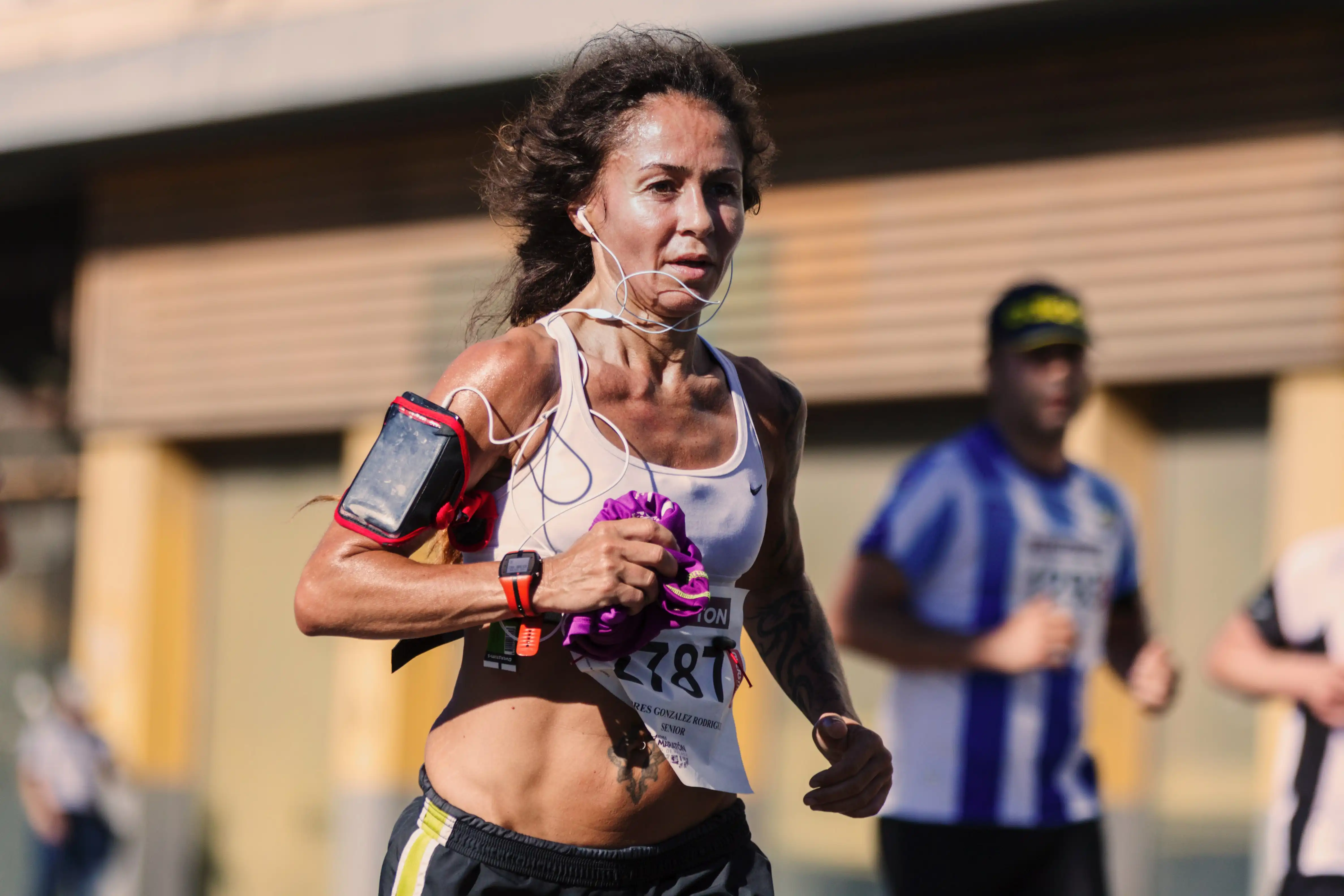
Pacing in triathlon has been analyzed for distances up to 60 long-distance triathlons in 60 days in men. However, no study has examined pacing in a female ultra-endurance triathlete in a multi-day triathlon exceeding 10 days. Thus, this case study analyzes the pacing of the first and only woman to complete 30 long-distance triathlons in 30 days. Lap times for swimming, cycling, and running, including transitions, were collected from race results. The athlete tracked each discipline daily using a Fenix 7 Sapphire Solar, recording average and maximum heart rates and energy expenditure. The coefficient of variation and second-order polynomial regression were calculated for average pace, split, and total times. Repeated measures ANOVA tested interactions in pace performance across 10-day phases and intra-discipline daily pacing variations. Multivariate regression examined physiological parameters’ impact on pacing. The female triathlete maintained a relatively even pacing strategy throughout the race, with a decrease in cycling speed and an increase in running speed. Cycling showed the strongest and significant correlation with total race time (r=0.810; p<0.001), while running (r=0.347; p=0.119) and swimming (r=-0.312; p=0.165) displayed non-significant associations. The pace varied within the disciplines, with cycling becoming slower and running faster in the last quarter of the race. Energy expenditure, maximum and average heart rate were significant predictors for cycling (R2=0.538; p<0.001), while only average heart rate was the best predictor for running performance (R2=0.450; p<0.001). Tactical considerations most likely influenced pacing, particularly in cycling and running. Future research should further explore pacing strategies in ultra-endurance events.