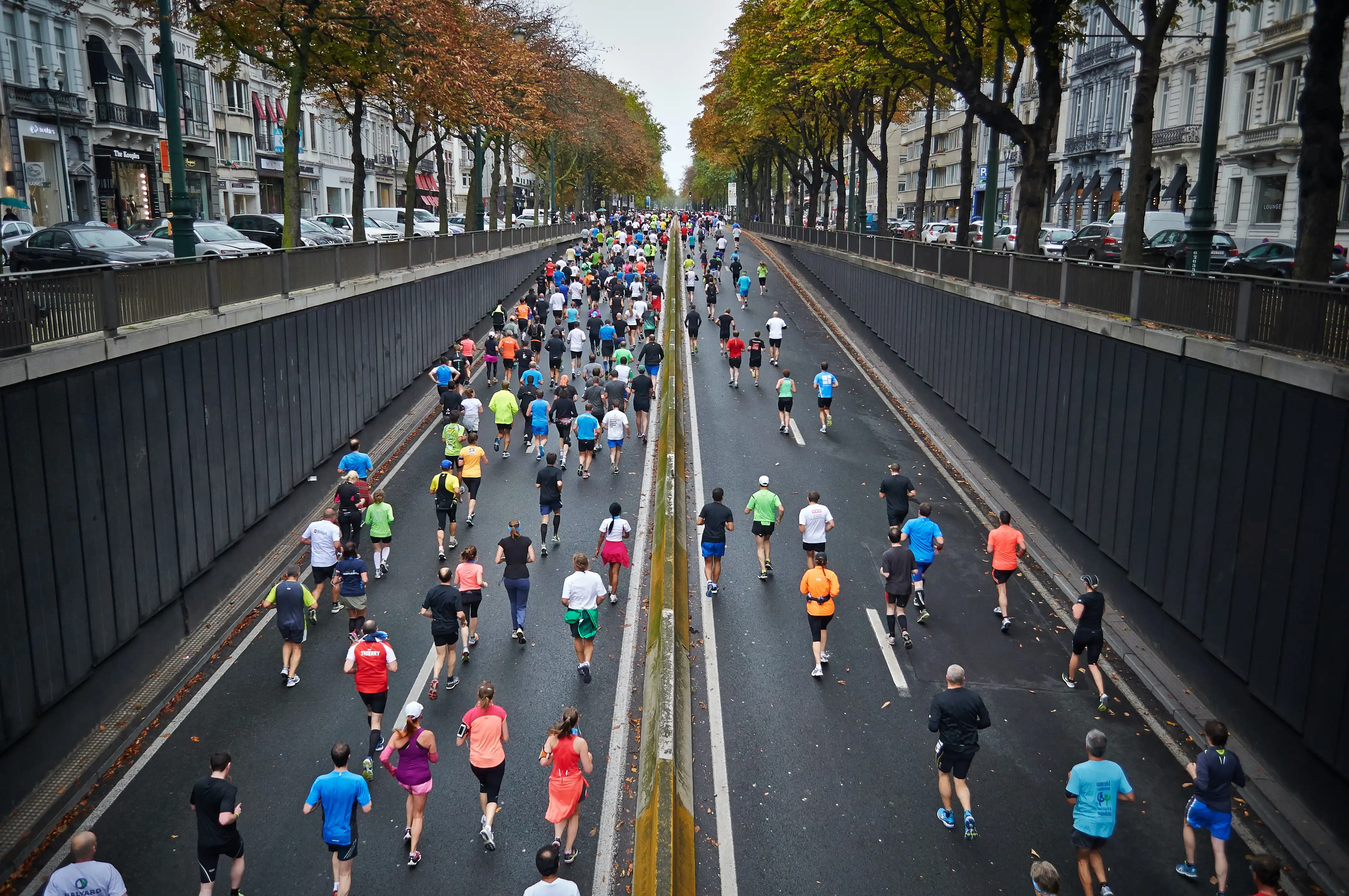
The role of weather conditions on running performance in the Boston Marathon from 1972 to 2018 This study examined the relationship between the weather conditions along with gender and country of origin with the mileage at the Boston Marathon from 1972 to 2018. A total of 580,990 observations of 382'209 different finishers with generalized additive mixed models were analyzed. Different groups and subgroups were considered as all runners, rank 101-200, 21-100, top 10 and the winners.The weather conditions in the course of the event were the average air temperature (° C), total precipitation (mm), the so-called WBGT (° C), the wind speed (km / h), the wind direction (front wind, side wind, tailwind) and barometric pressure (HPA). These effects were examined in a multi-variable model, together with gender, country of origin, calendar year, an interaction expression Country: Gender and a spline smooth term depending on calendar year and gender. In an increase in average temperature by 1 ° C, the performance was deteriorated (at 00:01:47 H: min: sec for all finalists and at 00:00:20 H: min: sec for the annual winners).Backwind improved the performance of all groups. The increase in precipitation was significant, which was due to the deteriorated performance in all groups except for the annual winner. The increasing wind speed was also associated with a deterioration of performance in all finishers and elite groups. Kenyans and Ethiopians were the fastest nationalities.The gender differences (men in all groups faster than women) were greatest in elite groups.
Our results contributed to the fact that the performance of the ‘Boston Marathon’ was known across the entire calendar years, taking into account mainly weather conditions, country of origin and gender. The work is complete to find under https://pubmed.ncbi.nlm.nih.gov/30849085/