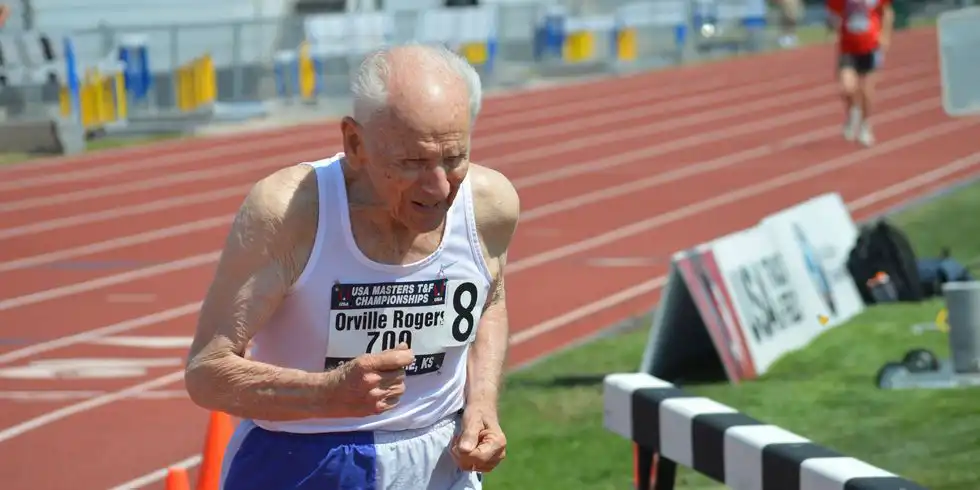
Pacing during and physiological response after a 12-hour ultra-marathon in a 95-year-old male runner In recent years, outstanding achievements of older people was reported up to 100 years.In this case study, the pacing was described during and the recreational phase after a 12-hour run for a 95-year runner.The athlete reached a total distance of 52.987 km. The pacing followed a parabolic pattern (U-shaped) in which the speed decreased to the middle of the race and then increased again.However, no final spurt was observed. If you divide the race in quartiles, a great effect of the first quarter was observed to speed, with the second quarter of slower than the first quarter and on.The smallest variability was shown in the first quarter and the largest in the second quarter. During the recreational phase, erythrocytes, hemoglobin and hematocrit took, while thrombocytes and leukocytes decreases.The metabolites CRP, GOT, GPT, Y-GT, CK and LDH were increased after the race and decreased again during regeneration on the reference area. In addition, creatinine and urea decreased during recovery.The creatinine clearance rose during the recovery phase.Sodium increased during the recovery phase and remained constant in the reference range. During regeneration, body fat and visceral fat mass decreased, while body water and muscle mass increases.
In summary, one can say that a 95-year-old man could walk for 12 hours and reached a total distance of almost 53 km. Increased selected hematological and biochemical parameters returned within a recovery phase to the values before the race. The case report can be found under https://www.ncbi.nlm.nih.gov/pmc/articles/pmc6338046/